The Way of Kings
The Way of KingsThe Way of Kings is an ancient guidebook associated with the Knights Radiant, a text whose counsel reaches into the political crisis of Alethkar and the private turmoil of Dalinar Kholin. Its decisive significance lies in the way its words transform reading into obligation: what begins as an old book becomes a source of ideals, a possible explanation for visions, a vocabulary for reform, and a warning that the world faces a coming catastrophe.
Nature and Historical Association
The book is presented as a work of ancient counsel, used by the Knights Radiant as a guide to how they should live. Its surviving words are therefore more than historical records or military instruction. They preserve an ethical standard tied to the lost orders and to the possibility that their ideals must be recovered. The volume is also connected to the book’s central invocation that the Knights Radiant must stand again, making it an object that joins the distant past to an unresolved future.
The text has an especially charged connection to Gavilar Kholin. Near the end of his life, Gavilar became fascinated by readings from the volume and spoke about it often. After his death, a message written in his own blood was identified as a quotation from the book: he urged his brother to find the most important words a man can say. The hidden message gives the book a second life as evidence of Gavilar’s strange final preoccupations and as a possible clue to what he had discovered or feared before his assassination.
Dalinar’s Reading and Visions
Dalinar cannot read the book himself, but he has had it read aloud to him several times. He keeps returning to its thick pages, filled with violet ink, and experiences the object almost physically, as though its words emanated from the page like Stormlight from a sphere. The book’s material presence thus becomes part of his uncertainty: it is simultaneously a revered source of ancient wisdom and a suspected cause of his mental disturbance.
Dalinar notices that his visions began several months after he first listened to readings from the book. This timing makes him question whether the text has somehow caused his problems, even as its ideals increasingly seem to explain the direction his conscience is taking. He is troubled by the possibility that his visions come from the Almighty, yet he also recognizes that his fascination with the book resembles the ideals and myths associated with the downfall of his brother. The tension is not simply between faith and skepticism; it is between a warrior’s old identity and the possibility that the book is demanding a different kind of service from him.
The book’s most forceful command in Dalinar’s visions is that he must unite his people, prepare for what is coming, and build a fortress of strength and peace against the winds. The warning ends with the declaration that the Everstorm is coming. These words give the book’s ethical language an urgent political consequence. Unity is no longer an abstract virtue or a historical curiosity: it becomes a condition of survival.
Political Counsel and National Unity
Dalinar applies the book’s message to the fragmented organization of the Alethi war effort. He recalls that Gavilar admired an older system in which the ten highprinces had distinct governing responsibilities, a structure intended to force them to work together rather than operate as wholly autonomous rulers. The memory offers Dalinar a practical model for translating the book’s command to unite into institutions rather than merely repeating it as a slogan.
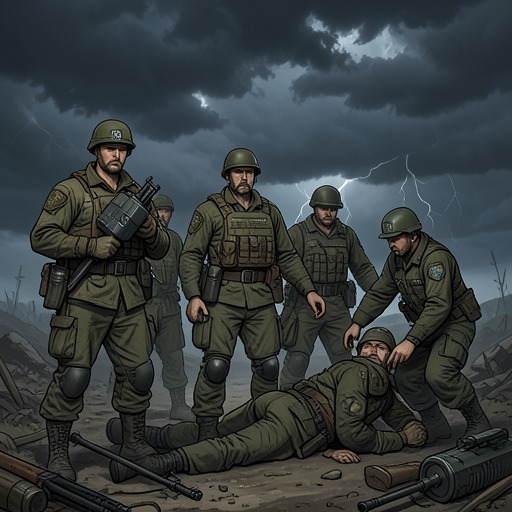
The political problem is sharpened by the war on the Shattered Plains. The ten armies fight separately against a single foe, and the highprinces treat the campaign as a competition for gemhearts rather than as a coordinated national war. Dalinar concludes that gemhearts are meaningless if the armies cannot accomplish their real purpose and that the highprinces’ squabbling is destroying the cause they claim to serve. The book’s influence therefore redirects his attention from revenge to state-building.
Dalinar proposes to become Highprince of War and enforce the Codes in all ten camps. He intends to coordinate plateau assaults directly, place all gemhearts under the Throne for redistribution as spoils, and turn the ten competing armies and their leaders into a real military force. This plan carries an immediate political danger: Elhokar Kholin fears that the highprinces will revolt and that the king himself will not survive the attempt. The book consequently functions as an instrument of reform whose ideals threaten the existing distribution of power.
Words, Ethics, and Catastrophe
The book’s counsel repeatedly collides with the ethics of expediency. When Dalinar asks what they are willing to give for vengeance, the answer is anything; he immediately tests that answer against the possibility of sacrificing everything Gavilar worked to build. The book’s importance lies in this contrast. It does not merely provide elevated language for the characters’ ambitions; it forces them to distinguish vengeance from loyalty and victory from the preservation of a people.
One passage Dalinar quotes concerns a journey from Abamabar to Urithiru, describing metaphor and experience as inseparable, with one explainable to others while the other remains personal. The passage helps him understand why lived experience cannot be reduced to an account that another person can simply receive. In the larger narrative, the book’s words operate in the same way: they can be read aloud, but their full significance is realized only through the choices they provoke in the person who hears them.
The text also intersects with reports from the dying. Taravangian says that the dying have begun speaking of something coming, and that the phenomenon started seven years earlier, around the time Gavilar first investigated the Shattered Plains. Their final words are treated as potentially useful warnings, because those on the threshold between life and death may see what is approaching. The book’s message about preparation and the Everstorm therefore belongs to a wider pattern of prophetic disturbance, even though the evidence does not reduce that pattern to a single explanation.
Narrative Significance
The Way of Kings is an object of circulation between eras, voices, and forms of authority. Gavilar’s private reading, Dalinar’s uncertain listening, the Knights Radiant’s lost discipline, and the dying’s cryptic warnings all gather around the book’s language. Its words move from a historical volume to a secret message, from a quotation to a vision, and from a vision to a program for reorganizing Alethkar.
Its power also remains unstable. Dalinar suspects that the book may have caused his visions, worries that his attraction to its ideals marks him as an old soldier pretending to be a philosopher, and recognizes that calls to unite can resemble the authoritarian language once used by the Hierocracy. The same command can inspire protection, reform, or conquest depending on who claims the authority to interpret it.
By the end of the available evidence, the book’s counsel has not produced completed unity, but it has changed Dalinar’s understanding of leadership. Its central demand is no longer confined to the page: it becomes a challenge to the divided highprinces, a response to the war’s waste, and a possible answer to the coming threat. The book’s enduring narrative role is to make recovery of the past an active choice in the present, asking whether ancient ideals can become living obligations rather than relics of a vanished order.